Case Study · Performance
Doctors Branding
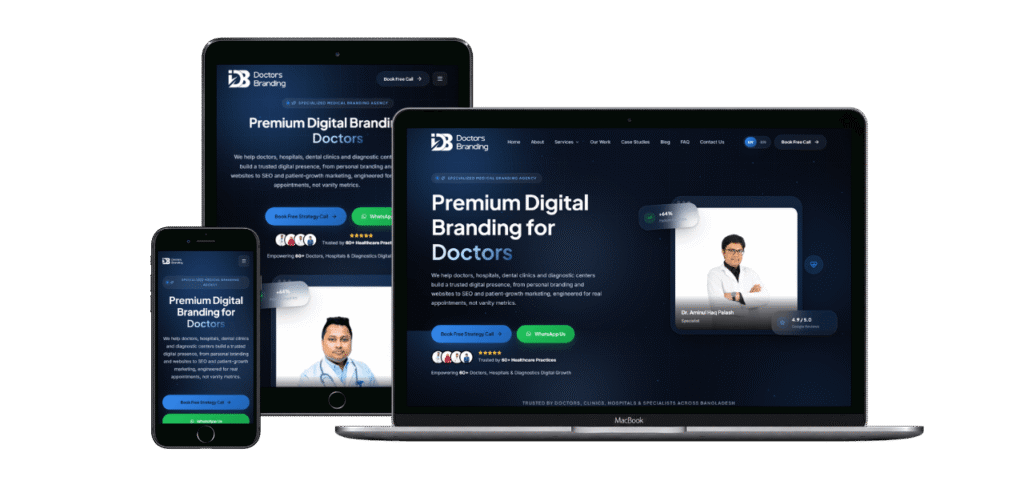
Doctors Branding is a healthcare-focused digital branding and marketing agency working with doctors and hospitals across Bangladesh. Its content-heavy WordPress site needed to load significantly faster on mobile and desktop without any loss of design, content, functionality or conversion flow. A structured optimisation pass took it to a 95+ PageSpeed Performance score on both.
- Role
- WordPress Performance Optimization
- Client
- Doctors Branding
- Year
- 2026
- Stack
- WordPress · Core Web Vitals · PageSpeed · Image Optimization · CSS · JavaScript
Visit live site · doctorsbranding.xyz
01 The challenge
Doctors Branding’s site is deliberately content-rich — healthcare branding services, doctor profiles, hospital content, creative showcases, video projects, testimonials, bilingual Bengali and English copy, and multiple lead-generation forms. The brief was to make it significantly faster without touching the design, content, functionality or conversion experience.
The goals we set before touching anything
- A 95+ PageSpeed Performance score on both mobile and desktop
- Faster initial load — fewer resources and a quicker time to visible content
- Oversized images, scripts, stylesheets and fonts identified and optimised
- Mobile treated as the priority, since healthcare users increasingly browse on phones
- No regressions to the existing visual design or functionality
- A maintainable foundation, not a one-off score bump that decays as new content is added
02 The solution
A structured optimisation pass across the frontend, the assets and the WordPress layer — making the same design more efficient rather than stripping it back.
Frontend asset optimisation
Audited the CSS and JavaScript loading strategy: removed unnecessary assets, cut unused CSS and JS, improved script loading order, stopped non-critical resources blocking render, and loaded assets only where they are actually used.
Image optimisation
Visual presentation is core to a branding site, so image delivery was optimised without losing quality — compressing oversized files, serving appropriately sized assets, trimming unnecessary payloads and improving above-the-fold delivery for doctor photography, creative work and project showcases.
Lazy loading and resource prioritisation
Prioritised what the first viewport needs and deferred the rest, in the order critical content → above-the-fold assets → interactive elements → below-the-fold content. This improves both perceived and measured speed.
CSS and JavaScript
- Removed redundant and unused CSS, tightened stylesheet organisation, minimised render-blocking
- Reduced unnecessary JavaScript, deferred non-critical scripts, improved load order and cut main-thread work
- Kept every responsive layout and required interaction intact
Fonts and third-party resources
Reviewed font and external-resource requirements and adjusted their loading so third-party requests no longer delay the primary page content.
WordPress frontend
At the CMS layer, reviewed the theme structure, plugin requirements, database-driven content and WordPress’s default frontend output — keeping the platform flexible for the Doctors Branding team while removing unnecessary processing and asset loading.
Mobile-first performance
Mobile was engineered as a first-class requirement rather than a desktop afterthought, so the full content and visual identity survive on smaller devices at speed.
03 Results
- 95+ PageSpeed Performance score on both mobile and desktop — the target, met
- Faster initial rendering, with critical content prioritised so visitors can interact sooner
- Large visual assets optimised to cut network transfer with no visible quality loss
- Unnecessary frontend resource overhead identified and reduced
- A more efficient WordPress frontend for asset and resource management
- Calls-to-action, consultation forms and service content all preserved — conversion-friendly performance
The score was reached without rebuilding around a stripped-down design or cutting business content. The goal was never “make the website smaller” — it was “make the website smarter”: optimise how resources are delivered, when they load and how the browser processes them, with the content and design experience intact.
For an agency whose site is the primary touchpoint for doctors and hospitals seeking branding, marketing and web services, a faster site is a better environment for first impressions, service discovery, lead generation, mobile browsing and search visibility — technical quality and business objectives in the same move.
Have a project like this?
Planning custom WordPress development, a performance rebuild, WooCommerce or an API integration? Let’s talk.
Let’s Talk